
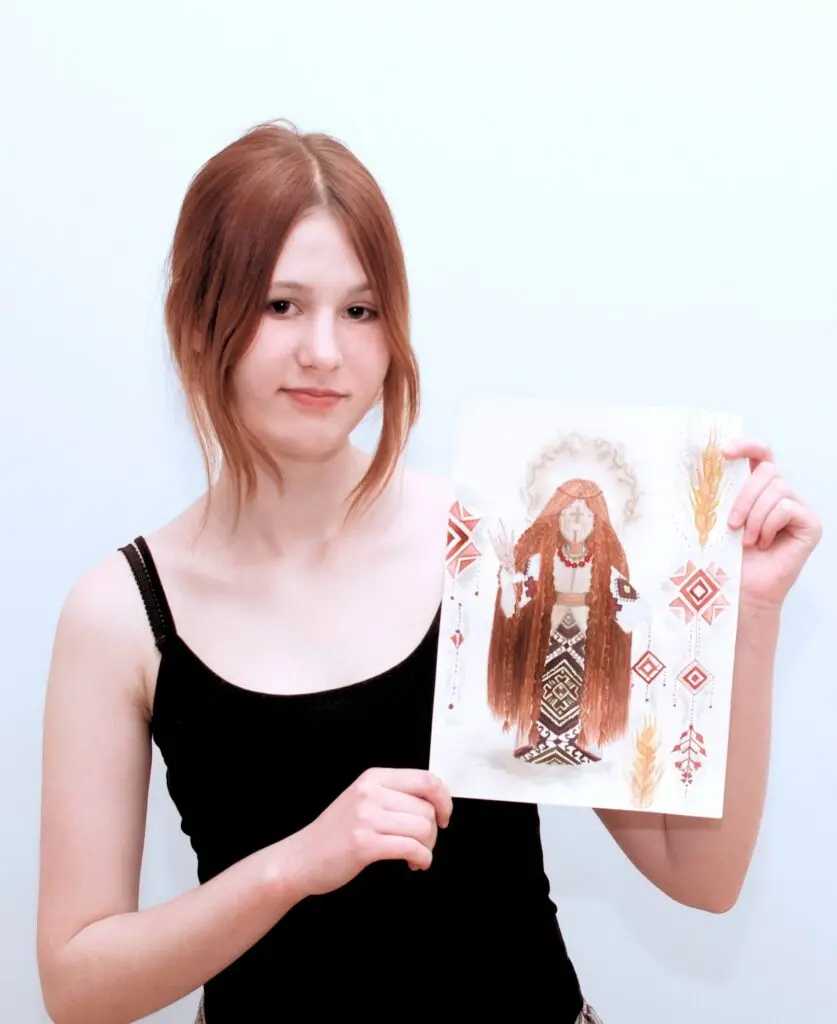
“I depicted Berehynia as a motanka – a Ukrainian talisman doll that has long symbolised protection, kindness and the strength of tradition. Motankas were made without a needle or thread – they were not sewn but wound. Such a doll was not just a toy – it was given to babies and children to protect them from evil and misfortune. My motanka has ears of wheat. Because today Ukrainian land suffers from wounds inflicted by shells every day. It is tired, but alive. And the ears of wheat are hope. Because even a tiny grain will sprout if you give it a little light, warmth and peace. I believe our land will recover. The ears of wheat are the whisper of our land, praying for peace and renewal. And so my Berehynia is not only about the past but also about the future of the Ukraine I love.”
“The disaster of war touched our family back in 2014. We spent days sitting in the basement – on water and biscuits. Good thing we had at least that. The shops hardly worked, and there was no electricity or water. In those two months, a great many elderly people died of hunger…” Yuliia Poltavets tells her family’s story.
Today she lives in Ivano-Frankivsk region with her two daughters, Mylana and Doroteia. When the enemy began shelling the city more and more, the family left for Kyiv, where her husband’s mother lives.
“We stayed there for two months. The shelling decreased, and we returned home. The city was wounded: the windows in our house were blown out, and on the asphalt there was dried blood that the rain had not yet washed away. But we were home,” Yuliia continues.
Later Doroteia was born and Mylana started first grade. It seemed life was getting back on track a little.
“But that feeling of anxiety deep in my soul never went away… On 24 February 2022, at 5 a.m., there was an explosion at the airfield. We were back in 2014 again. We silently packed our emergency backpacks and waited for their dad, who was supposed to return from a business trip. Two weeks of sirens, explosions and hope that everything would be fine any minute. Friends invited us to Ivano-Frankivsk region. Evacuations began, and we left – with three backpacks, two cats and guinea pigs. 32 hours on the road – almost all of it standing,” the girls’ mother recalls.
On 10 March 2022, the family reached Burshtyn. Six months later, the girls started school there.
Since then, the family has settled in the town. The adults have found work, and the girls have found friends.
They dream that the war will finally end so that they can return to their native Kramatorsk.
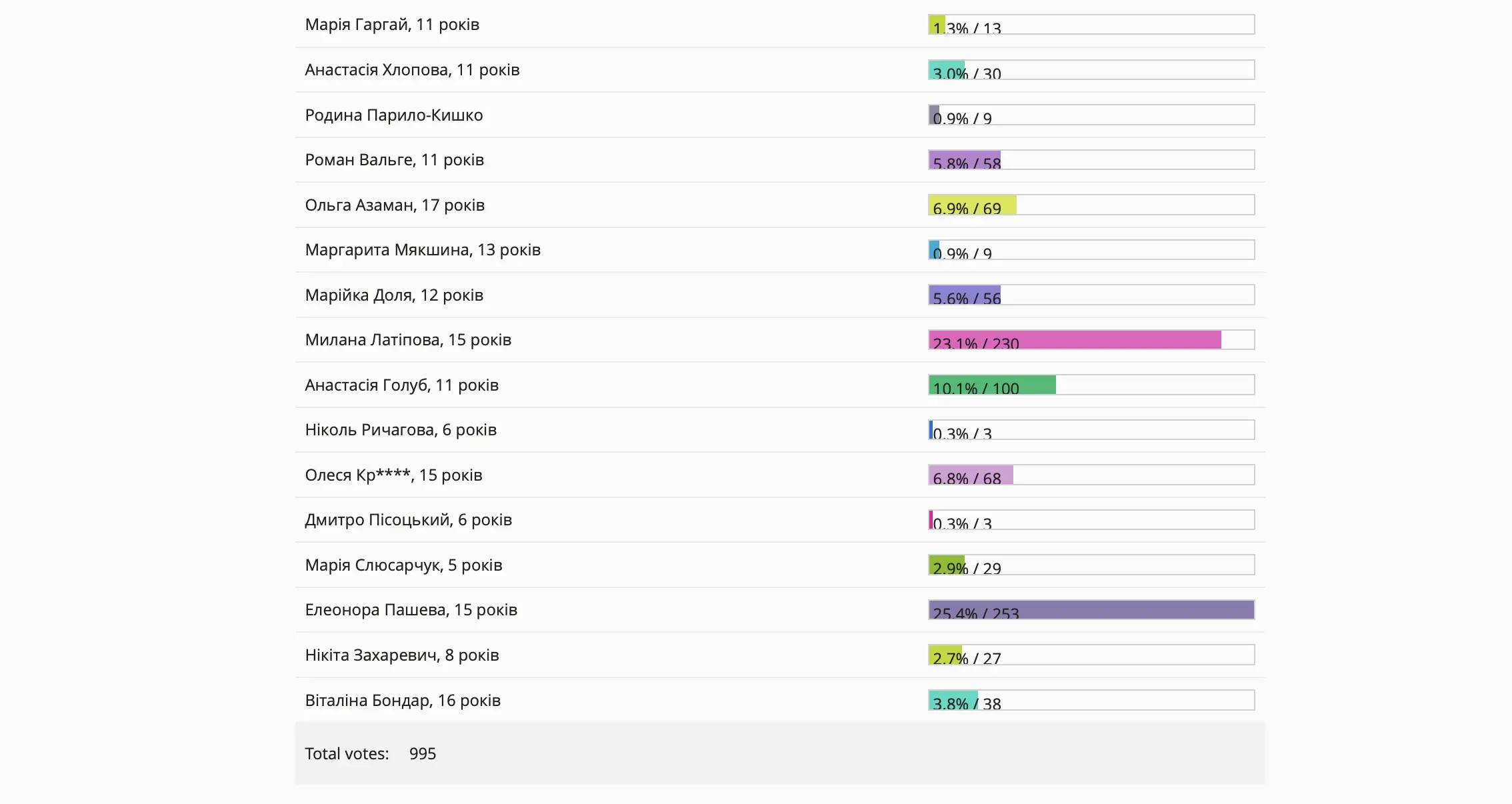
Voting results