
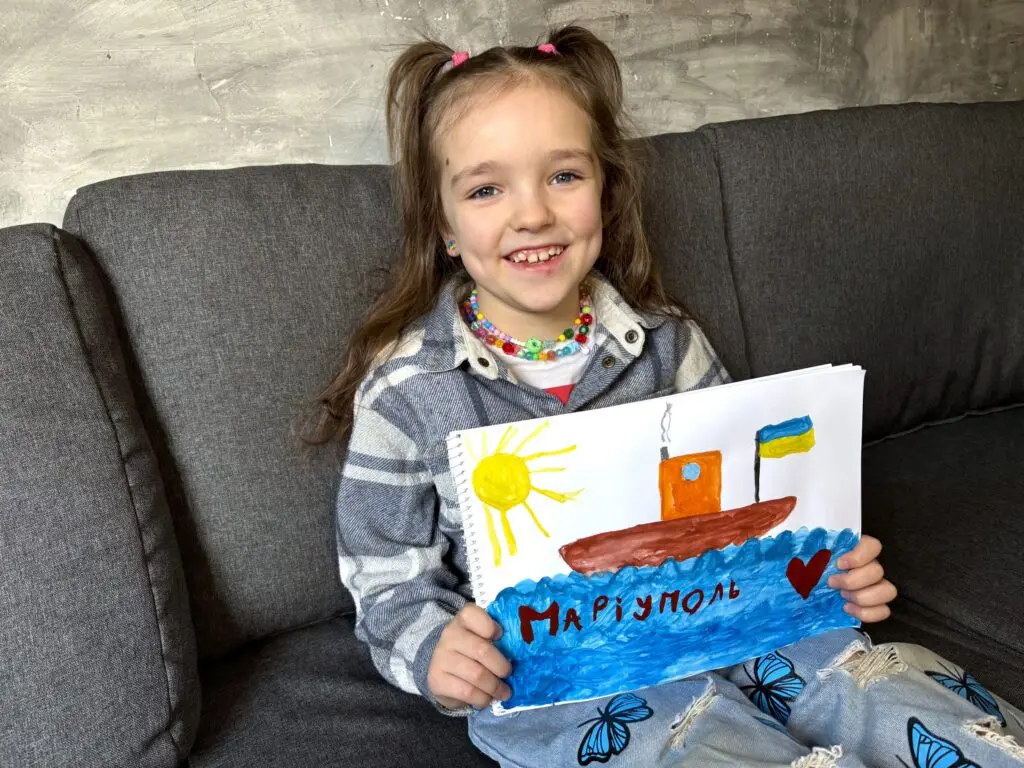
The Kovalenkova-Rychahov family – Olena, her husband Oleksandr and their two children, the elder Volodia and little Nikol – are from Mariupol. Shortly before the full-scale invasion, they bought their dream flat there – the sea and the port could be seen from the window. The beach was just a 5-minute walk away.
“On 24 February we woke up at 6:30 to explosions and wailing sirens. We hoped everything would be like in 2014, when it was all over in a few days. Some military acquaintances called me and advised us to leave the flat, as it had a commanding view. That same evening we went to my husband’s parents. We lived there for a month. We were lucky it was on the ground floor. But the enemy shelled the building every day. It felt as if it was collapsing. A few days later we went outside and came under mortar fire; after that, the children never went outside again,” Olena Kovalenkova recalls the beginning of the full-scale war.
She says that around 2 March the electricity and water were cut off, and a few days later the gas and mobile network.
“We cooked in the yard; we made porridge because it needed the least water. By 8 March we had no water left; we melted snow and collected water from the drainpipes of the high-rise building. The windows in the flat were broken, and the temperature was minus 6. We constantly wore several jackets and didn’t take off our hats even at night. Personal hygiene was out of the question, because there was not even water to drink. Every day felt like the last. Every night at about 2 a.m., planes began flying and dropping bombs. You lie there and hear it getting closer, dropping a bomb, and the bomb falls for about 15 seconds – I will never forget that sound. You close your eyes and realise you have another 15 minutes while the plane flies off to reload. I fell asleep, covering my ears with my fingers, because I knew that, if it hit our building, even the basement would not be safe – such bombs destroyed two entrances of a nine-storey building,” continues Volodia and Nikol’s mother.
Olena says it got worse every day. Food was running out, there was no water, but there was no way to leave either.
The people who remained in Mariupol at that time were cut off from the world.
“On 16 March there was information about a green corridor, and through the window we saw neighbours starting to leave. But a few hours later they came back in wrecked cars, wounded. There were more and more wounded and dead. In the first days, people were covered with sheets, but later the bodies lay in the open. My son Volodia asked me why they weren’t buried. Our district was occupied on 12 March. There was a curfew and endless checks of documents and homes. They just came in whenever they wanted, looked at whatever they wanted, took someone away with them, and we never saw those people again. Around 18 March they began handing out bread and ‘starter packs’, but we hated them so much that we didn’t want to take anything,” the woman continues.
The children fell ill. The medicine ran out. The little ones had a temperature of almost 40 that wouldn’t go down.
“My husband went to the hospital. They gave him ibuprofen and said it was the last. I couldn’t bear it. There was no transport, no connection, and the children were sick. We were told that sometimes there was an evacuation bus in another district and you could leave for nearby villages, where there were basic supplies. We left home on 26 March and decided to walk. On the highway, a man named Volodymyr agreed to drive us to the nearest village. He was a volunteer; at the checkpoints they pointed guns at us and asked how much we had paid him. Perhaps because the children really did have a temperature, they believed us, but they mocked the driver. That same day we reached an area with mobile coverage, called a taxi and got to Berdiansk. When we arrived, we rented a room by the day, but by evening the mobile network disappeared there too. For a week we sat in a field: at 6:30 in the morning we were there waiting for the evacuation bus, and in the evening we returned to the rented room. A week later, 50 buses arrived, and the next day at 2 a.m. we were in Zaporizhzhia. In Ukrainian Zaporizhzhia. Everyone cried,” Olena shares what they went through.
The family reached Lviv on 8 April by evacuation train. They immediately started looking for a flat.
“But unfortunately, no one wanted to rent us a flat. While I was talking on the phone near the Administrative Service Centre, a man overheard my conversation and advised us to apply to the dormitory where we now live. It has become our second home. When we walked into the unrenovated room, I cried with joy that we would finally have at least some place to live,” continues Volodia and Nikol’s mother.
The first couple of months were difficult for the Kovalenkov family. Neither Oleksandr nor Olena could find work, and they couldn’t get the children into kindergarten and school.
“Later everything worked out, and my husband went to work. I couldn’t get a job because my daughter was still small, and the kindergarten was open until 4:30 p.m. Employers refused to hire me part-time. But that same year I enrolled at the Mariupol Azov State University to study social work. I studied full-time online and received a 3,000-hryvnia scholarship. Plus, talking to the lecturers kept me from losing my mind. That is how I recovered a little. And already in my first year, I started working in my field,” Olena rejoices.
The children go to school. Volodia is in sixth grade, Nikol in first.
“Volodia is already 12. He is a grown-up boy. He has a duty – to take his little sister to school and pick her up. He loves cooking, attends a cycling club and takes part in competitions. Nika also goes to a chess club and loves roller skating. She has a best friend who also lives in the dormitory,” Olena continues.
The Kovalenkov family has one shared dream – a peaceful sky and the sea.
“We always dream about how we will live by the sea, walk to it, greet the dawn and swim until sunset,” she admits.
Voting results