
Vinnytsia region: Rokada presented a study on the factors that influence people’s decisions to stay in their communities
Safety in communities, employment opportunities and the accessibility of social services are the key factors influencing people’s decisions to stay in the communities of Vinnytsia region. Rokada presented a study carried out by the Socioinform public opinion research centre, commissioned by the Foundation within the project “Strengthening Community Resilience for Return and Reintegration”.
The survey was conducted in three communities – Tulchyn, Bar and Ladyzhyn. More than fifty residents, both local and internally displaced, took part. Officials and representatives of civil society and business also joined the study. It was made possible within the project “YOUA – Shaping New Paths, Building Ukraine’s Future”, commissioned by the German Government and implemented by GIZ Ukraine: Sustainable Economic Development.
According to official data, since the beginning of the full-scale invasion, between 6% and 20% of residents have left these communities, while evacuees arriving have made up between 2.5% and 10%.
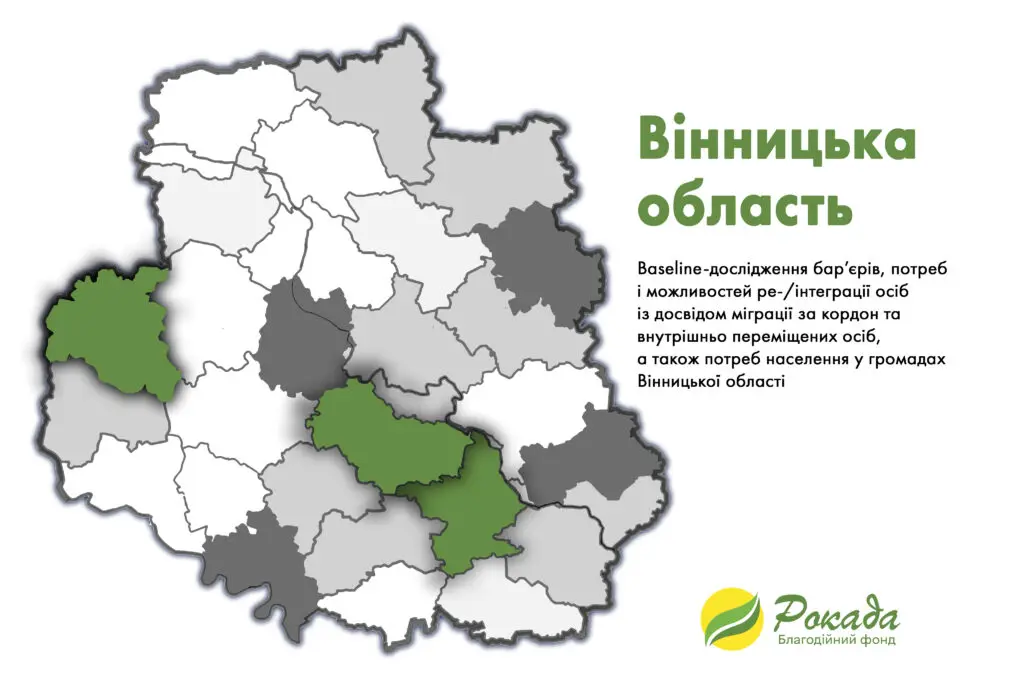
“This is the second region where we have conducted research within the project. Just as in Lviv region, specialists looked at the factors that encourage people to stay in communities and those that drive population outflow,” explains Project Manager Alla Krasovska. “Respondents in the Tulchyn, Bar and Ladyzhyn communities pointed, among other things, to the need to create a housing fund, including first-stage housing, to ensure equal access to support, and to strengthen cooperation with educational institutions for retraining.”
The communities themselves noted that, despite their interest in integrating internally displaced people and reintegrating those returning from abroad, they still lack the resources to meet all needs.
“Unfortunately, communities are unable to provide people with housing and the full range of necessary social services. Yes, they try to provide comprehensive support through their own programmes and donor funding. But it is not enough. So institutional development, modernising management approaches and gaining new knowledge are pressing issues. In particular, this concerned grant writing and project management, digital technologies and developing the competences of specialists working in the social sector,” continues Alla Krasovska.
So far, families with children and residents aged 40–50 who have been able to buy or rent housing have integrated most actively in the communities.
The Project Manager stresses that the study will serve as a basis for further work with communities on developing practical solutions and strengthening local capacity in integration, reintegration and preserving human potential.
“The issue of Ukrainians returning from abroad is extremely relevant. But it can be solved when communities create opportunities for employment, education, solving housing issues and so on. A lot depends on how communities organise these services locally. The study is useful for our understanding of further work, cooperation mechanisms and the procedures we will develop to bring people home,” says Svitlana Yarmolenko, Director of the Department of Social and Youth Policy of the Vinnytsia Regional Military Administration.
The YOUA project provides exclusively technical assistance and does not influence people’s personal decisions about returning to Ukraine. Participation in events and use of services are possible exclusively on a voluntary basis for persons who are considering returning, have already made such a decision or are in the process of reintegration after returning to Ukraine.